Dispute over UBS: ‘That statement is utter nonsense’
Sergio Ermotti is toughening his rhetoric in the dispute over future banking regulation. In an interview with the Neue Zürcher Zeitung (NZZ), the UBS chief accuses the Swiss National Bank, the Swiss Financial Market Supervisory Authority and Karin Keller-Sutter’s Federal Department of Finance of having ‘no interest’ in ensuring ‘that the real lessons of the Credit Suisse collapse are learned’. After all, he argues, they ‘share responsibility for what happened to CS’.
The UBS boss is not much kinder in his comments about politicians: ‘Some have understood UBS’s position, others do not want to understand it, and still others are confused.’ This is not going down particularly well in political Bern. ‘Sergio Ermotti is perfectly entitled to defend UBS’s interests with his arguments’, says Andrea Caroni, FDP member of the Council of States for Appenzell Ausserrhoden. ‘But he should grant that same right to those who defend other, more public interests.’ But he doesn’t. To put it bluntly, he portrays anyone with a different opinion as either malicious or stupid.’ And the member of the Council of States adds: ‘This kind of attitude does not sit well with my basic understanding of democracy.’
Other members of the Council of States see the interview as proof that nerves are running high. ‘The level of lobbying I am currently seeing from UBS is unparalleled in my experience’, says Pirmin Bischof, who was elected to parliament in 2007 and has represented the canton of Solothurn in the Council of States since 2011. ‘UBS’s leadership represents the interests of its shareholders; we represent the people of the country. One would expect the bank to understand that.’ He takes the UBS chief’s latest attacks ‘in his stride’, as he puts it. ‘It’s all part of the game.’
‘If you attack the integrity of your political opponents, you have obviously run out of arguments’, adds Peter Hegglin, the Centre party member of the Council of States for Zug. As a politician, he says, he also relies on academic experts and on reports from the authorities when making decisions. 'We politicians have to consider the interests of both the financial centre and taxpayers', Hegglin stresses. That is why he has put forward a proposal of his own, which he describes as a ‘compromise’. Under this proposal, UBS would have to back its foreign subsidiaries with 'only' 90 per cent Common Equity Tier 1 (CET1) capital, rather than the 100 per cent the Federal Council wants. The Federal Council's proposal is 'far-reaching', says Hegglin, 'while the committee's proposal involving AT1 bonds does not seem workable to me.'
‘100 per cent would be better!’
Hegglin's 90 per cent proposal has won support from, among others, Zug-based asset manager Pirmin Hotz, according to a letter he sent to members of the Council of States, which has been seen by ‘Schweiz heute’. In it, Hotz describes the 90 per cent proposal as 'acceptable', though he adds: '100 per cent would be better!' As the owner of an independent Swiss asset management firm, he says, a strong and competitive UBS is 'very close to his heart', all the more so as it serves as his firm's custodian bank for around CHF 5 billion in client assets.
But Hotz fired off his Sunday missive for a different reason: the political debate programme Arena on the topic of UBS’s capital requirements. It was claimed on the programme that requiring UBS's foreign subsidiaries to be backed 100 per cent by equity would be like requiring flat owners and homeowners to fund their property entirely from their own funds, meaning they could ultimately no longer take out a mortgage. 'That statement is utter nonsense', Hotz insists.
Requiring foreign subsidiaries to be backed 100 per cent by equity does not mean that they would no longer be allowed to raise debt, he says. 'Rather, it means that the book value of the Swiss parent company's holdings in its foreign subsidiaries must be financed 100 per cent with the parent company's CET1 capital', Hotz stresses. Even under the Federal Council's proposal, experience suggests that the foreign subsidiaries' debt-to-equity ratio would exceed 10:1 – but the '1', that is, the equity, would now be funded entirely by the company’s own capital.
Ermotti, who must be well aware that the comparison with homeowners is flawed, prefers other analogies in his skirmishes with the authorities and politicians to spell out the consequences of the 90 per cent and 100 per cent CET1 proposals respectively: 'two black eyes and a broken nose.'



Author
Florence Vuichard (External)
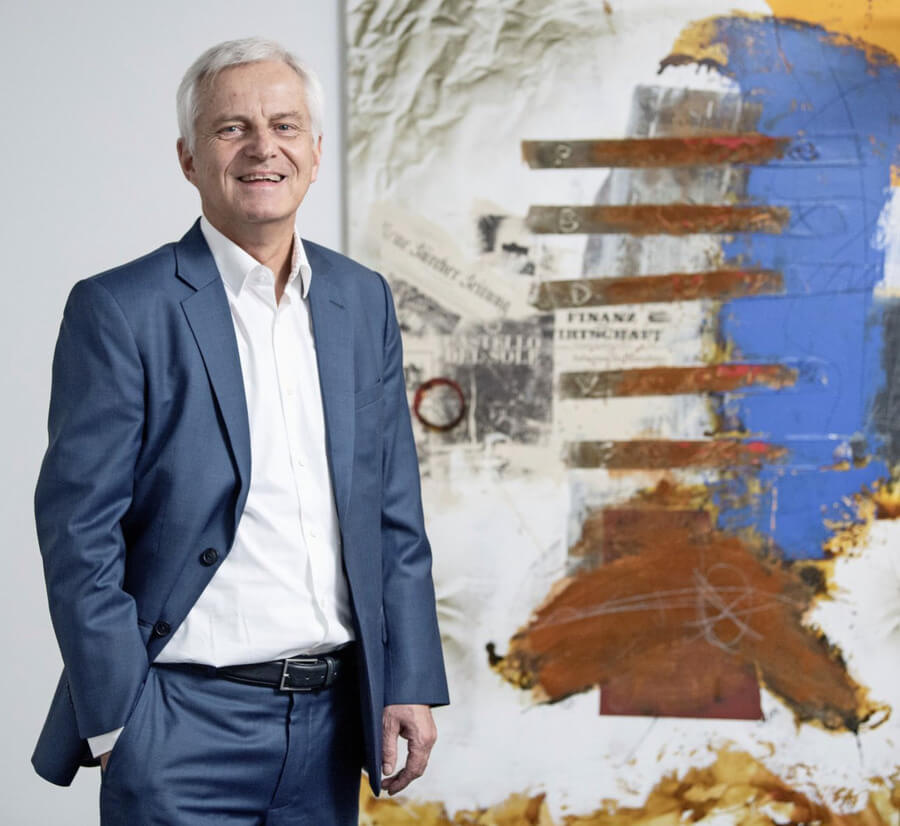
Photo: Pius Amrein
- Conflicts of interest
- Pressure to sell