
Against blind faith in models
While fluctuation reserves were frequently calculated very approximately using the practioner method twenty years ago, financial economics methods are commonly used today. This translates into only a scant reduction in margins of discretion.
Years ago, as a young academic, I was astonished by a statement made by the Chair of the Board of Trustees at a meeting: the reserve ratios for the applied practitioner method would be selected to create a target reserve of 18% for a given strategy. I found this “backwards engineering” highly subjective and therefore not very professional. It seemed clear to me that the objective financial economics method must be applied, especially as it is the only one to consider diversification effects.
Now, though, after years of experience with pension funds and calculating their fluctuation reserves, I have to revise my judgement, partly at least. The financial economics method is undoubtedly appropriate, but does not guarantee complete objectivity and fails to calculate the correct reserve. This is because the leeway for choosing the various parameters and, in particular, for calculating the risk/return characteristics merely shifts the subjectivity to a higher level and, in doing so, conceals it better than with the practitioner method.
Dependence on the security level ...
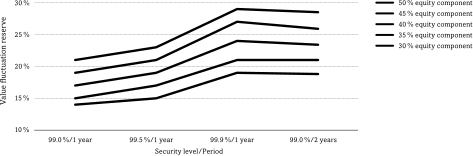
We will take an imaginary pension fund as an example. Its allocation is: 40% equities (of which 10% Swiss equities), 20% Swiss property, 35% bonds (Swiss francs) and 5% liquidity. With an envisaged yield of 1.25% and long-term risk/return characteristics1, the target value for the fluctuation reserve varies considerably depending on the level of security: the target reserve would be 17% if the Board of Trustees wants the reserve to be sufficient in 99 out of 100 years (99% security level) to compensate for market fluctuations and the envisaged yield. If less security is required, the target reserve is significantly lower: 11% for a 95% security level and 14% for 97.5%. But the target value for the fluctuation reserve rises to 24% (see chart) if the Board of Trustees wishes to adopt a highly conservative approach and sets the security level at 99.9%.
Target reserve for pension funds with varying equity exposure (and a fixed 20% real estate allocation) at different security levels
This choice of parameters and the associated subjectivity of calculating the target reserve do not represent an endorsement of specifications in technical guidelines or regulations – on the contrary. It is good for the Board of Trustees to have discretionary powers and hence to be required to form an opinion on an appropriate magnitude of reserves. On average, Swiss pension funds held 16.5% fluctuation reserves with 62% real asset investments at the end of 2024.2 A sufficiently well-endowed fluctuation reserve helps to maintain disciplined adherence to the investment strategy, even in turbulent times. This is because experts often call on investors to engage in pro-cyclic risk reduction during periods of crisis – in other words, to sell shares. But the consequences of such an untimely change in strategy can be devastating, as the pension fund effectively abandons any hope of recovery. It's like having a reserve of road grit for the winter: the amount was selected to ensure it would be enough. But no one should start feeling nervous if it starts to dwindle towards the end of winter.
... and on the basics
Inconsistencies in the risk/return fundamentals are a common problem when assessing the scope of target reserves. The risk parameters are particularly important here. Those in control have difficulty detecting abrupt changes in assumed volatilities (fluctuations) and correlations (interdependencies between asset classes), despite their immense impact.
This problem occurs if the periods used for the underlying data series are too short. After all, these risk parameters go down when the markets experience fair weather phases, which lowers the need for fluctuation reserves. But volatilities can rise sharply in bear markets, accompanied by a massive increase in correlations. The target value for fluctuation reserves shoots up at the precise moment when part of the current reserve has already been utilised. This type of calculation is not appropriate and can spread unnecessary nervousness among those in charge. The risk of incorrect, pro-cyclical decisions with regard to strategy adjustments increases.
Same investment strategy, twice the reserve requirement
This will be illustrated using a historical example of the pension fund with the above strategy. The pension fund calculates the risk parameters (volatilities and correlations) for measuring the fluctuation reserve based on data from a 5-year time window. At the beginning of 2008, the first bad news about sub-prime mortgages led to a recalculation using data from 2003 to 2007. Given an envisaged yield of 1.25% and a security level of 99%, this resulted in a reserve requirement of 8%. At that time, the pension fund felt safe with its fluctuation reserve of 10% and a coverage ratio of 110%.
The financial crisis took its course and the coverage ratio fell well below 100% over 2009, settling at 102% by the end of the year. But this meant a fluctuation reserve of just 2%. The Board of Trustees decided to obtain certainty as to the target requirement for the fluctuation reserve. This time, the risk parameters were based on data from 2005 to 2009 – so again a period of five years. With all other factors constant, the reserve requirement shot up to an astonishing 16% despite having been 8% in the most recent calculation.
But shifting the short 5-year window by two years had added the crisis years of 2008 and 2009. Risk parameters increased significantly – average volatility rose by half, while average correlation tripled – resulting in sky-rocketing reserve requirements.
These pro-cyclical increases in reserve requirements must be avoided. It is therefore necessary to draw on sufficiently long data series to obtain a stable calculation of risk parameters.
TAKE AWAYS
- Discretionary powers remain, irrespective of whether the practitioner method or the actuarial method is used.
- There is no right level of fluctuation reserves; the Board of Trustees must form an opinion.
- A cautious approach to reserves is recommended, as this helps to remain true to the investment strategy, even in difficult phases. This is crucial for long-term investment success.
- Pro-cyclical increases in reserve requirements must be avoided; therefore, sufficiently long data series should be used for the stable calculation of risk parameters.
1Risk parameters are based on data since 1979, while anticipated yields are calculated using historically proven risk premiums on current interest rate structures.
2 PPCmetrics AG, Pensionskassen-Jahrbuch, 2025 edition.

Thomas Hauser
Dr. rer. pol., Managing Partner, Dr. Pirmin Hotz Vermögensverwaltungen AG
- Long-term